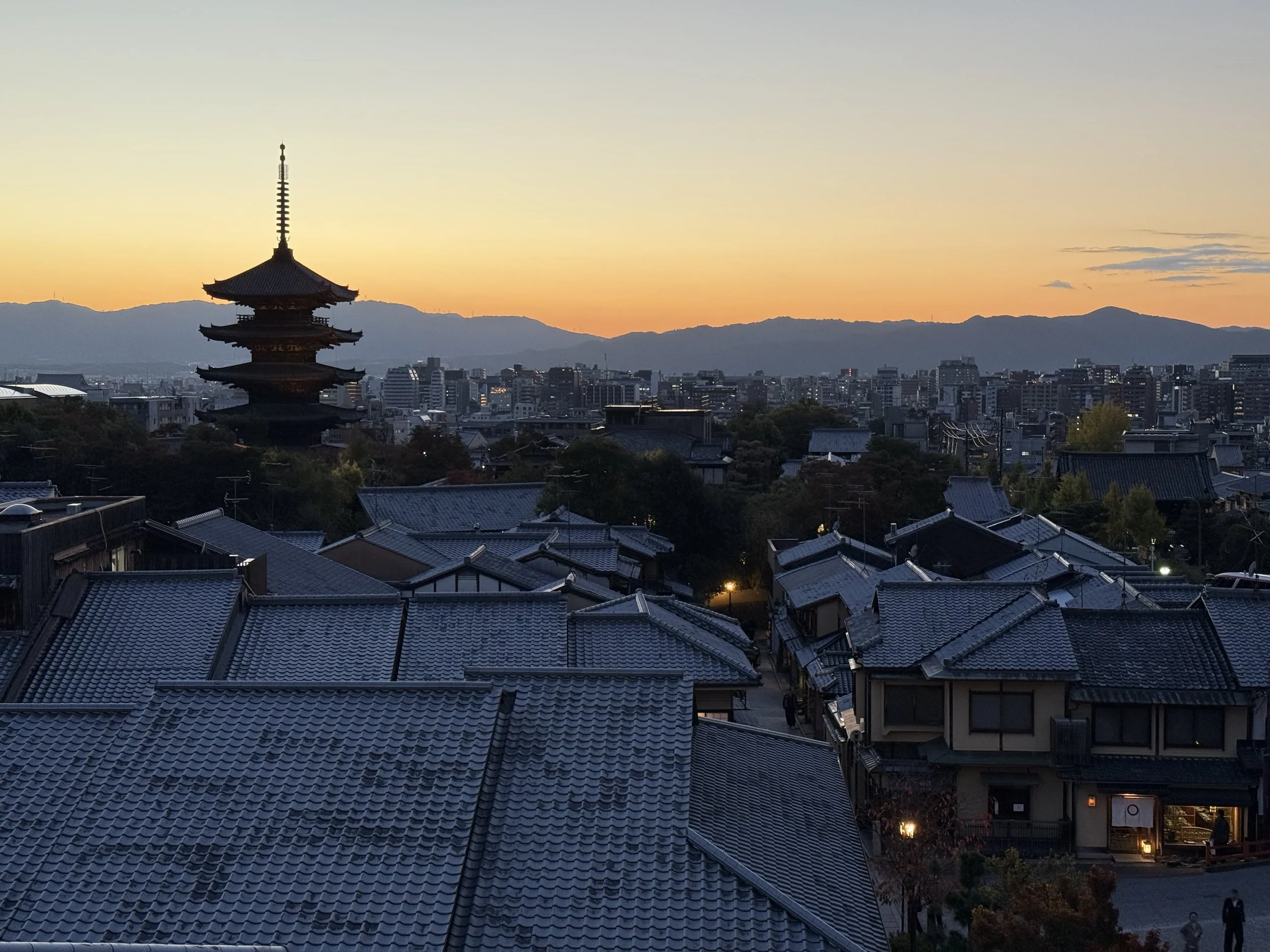
The sun setting behind Nishiyama, while the Yasaka Pagoda (built in 1440) towers in the foreground
Before a retired general began describing what adversaries are doing to satellites, the room was asked to turn over our conference badges and smell them. The organizers had scented the backs. The general's reasoning was that the next twenty minutes would be unpleasant and we might want something to offset it.
That was Wednesday in Kyoto, at a gathering of space, defense and science founders together with the people who fund them and buy from them. It ran under the Chatham House Rule, so I will only describe ideas discussed without ascribing attribution to any person or organization.
My notes from the conversations fill many pages, and most of them concern waiting. People were waiting for a software change to be approved for a submarine, for a slot on a rocket, for a payload to be attached to that rocket, for an experiment to finish, for a prospective partner in Japan to indicate that a second meeting would be welcome. Hardly anyone on stage was short of ideas or, this year, of capital. They were short of throughput, and I came away thinking that the best businesses described were each an attack on some queue.
The queues
A former admiral told of software modifications that needed years of approval and then reached a few hulls at a time. A founder who builds drones has been through fifteen to twenty hardware revisions of one vehicle in three and a half years and still faces a review board for each software release. Any change to the battery management system means the battery is recertified. The units fighting in Ukraine, this founder said, push updates daily and occasionally hourly. I was left thinking - I would back a company that did nothing except compress that certification loop, because every drone maker selling to the DoW is standing in the same line.
On launch, an executive at a rocket company asked the investors present to consider launch access as execution risk in diligence, since a slipped launch moves revenue and every financing milestone behind it. An astronaut on the same panel located the delay somewhere less obvious: Florida can now launch several rockets in a day and the scarce thing is floor space in the facilities where payloads are prepared and mounted. Japan wants thirty launches a year in the 2030s, and at that rate, the negotiations with local fishing unions become a scheduling problem of their own.
The same astronaut was asked which technology had been most missed in orbit. The first answer was a Japanese washlet! The serious answer was the ability to upgrade a station's computers without stringing new cable through the cabin, because crews live for decades with hardware designed decades earlier.
The talk that drew the most attention described robotic laboratories directed by an AI system, in which an experiment that takes a human team months to design and run is completed in hours. The speaker's argument for building physical labs was blunt. A model that tests a hypothesis against the published literature is checking one guess against another. The company is building a massive facility whose floors are seven feet of concrete so that instruments can be stacked vertically. There was no pretense that this is easy, but I can’t wait to live in a world where science is bounded not my lab space and speed of experimentation, but simply by human curiosity.
Generalists and specialists
The disagreement I found most useful was not debated out loud, only because the two speakers were hours apart.
The laboratory speaker invoked what machine learning researchers call the bitter lesson, which holds that over a long enough period a general system beats a specialized one. The same speaker applies it to science itself. The division into chemistry, biology and materials is a human convenience, on this view, and a system trained across all of them will find what specialists miss. That afternoon the drone founder said nearly the reverse about robots. The vehicles that work, according to the founder, are those in which one team owns the hardware and the software, and autonomy software sold as portable to any platform ends up worse than a purpose-built stack.
I believe both are right about their own domains, and the reason is important for anyone allocating capital. Generality pays when data is plentiful and a wrong answer costs little, as with thousands of automated experiments. A drone a hundred meters down in a contested strait has neither luxury nor the tightly integrated designs to keep winning there for some years.
The launch panel underscored the caveat. Operators who had built satellites around one rocket were forced to redesign them when politics took that rocket off the market. The lesson I draw is to integrate inside the product and to stay unattached at its interfaces with suppliers.
Commercial satellites are now targets
The general described anti-satellite weapons, jamming and cyber intrusion as daily business. A week or two ago, by the panel's account, a Russian satellite pulled alongside a European commercial radar imaging satellite and did nothing further. The general called it a bully operation whose purpose was to show that it could be done. No government has said what it would do if a private spacecraft were attacked, and commercial space stations are expected to force the question.
An astronaut gave the debris version in numbers. On a two-week shuttle flight in 2009, an avoidance maneuver was rare. During six months aboard the station in 2013, the crew sheltered in the return capsule twice. In 2020 it happened about five times, twice with suits on and hatches closed.
The same astronaut described a dinner on the station in 2009 with crew from all five partner agencies, thirteen people around one table with food from each country, and admitted to still finding it hard to believe that Americans and Russians fly together.
I found the astronaut’s dinner anecdote moving, but the general’s cautionary tale more useful for underwriting.
Japan
Nearly every American on stage asked Japan to move faster. One founder recalled asking, after a first meeting with a Japanese heavy industrial firm, what the next step was. The hosts explained that one does not ask and waits. That founder has been back six or seven times. The founders with Japanese money on their cap tables got it by making those repeat trips, and the day's most practiced fundraiser said that "money moves at the speed of trust”. I take the complaints about pace as a description of the entry fee.
That fundraiser also made the observation I have repeated most since. Tell an American company that a system does the work of ten scientists, the argument ran, and it lets nine of them go, while a Japanese company concludes that its ten now produce what a hundred did.
With a shrinking workforce and factories that scale better than anyone's, Japan may be the better first market for scientific AI.
What I did not buy
One speaker predicted that within twenty years all military command would be issued from orbit. I do not see armed forces placing their command structure in the domain the general had just spent twenty minutes describing as the most exposed.
I am also unpersuaded on in-space manufacturing at scale. The astronaut's own advice was modest, that a company should treat microgravity as one option out of many in its R&D portfolio and see whether it earns a place. I agree with that, and I would not yet underwrite a commercial station on pharmaceutical tenants.
The case for thousands of cheap drones has a hole that its own advocate pointed out. The question was what a navy does with a stockpile once the hardware is obsolete, which on that advocate's timeline could be within months. Nobody answered it.
Where I would put money
In the order I would fund them:
Haha I’m not going to write this out here.
If you’re keen to know, we may be hiring
ありがとうございます