Every now and then, an idea makes you pause and go “Huh. I hadn’t thought of that. But now that you put it this way…..”.
Last week, a thoughtful tweet by Clark Tang caught my attention:
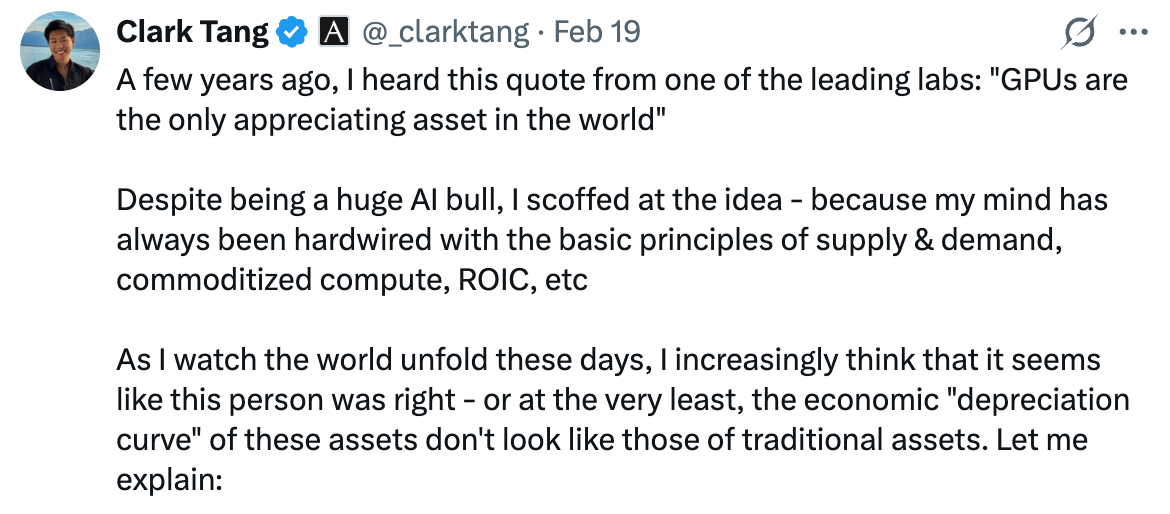
Some assets do appreciate. Land. Bars of gold. Bitcoin (jk). I never once thought that silicon belonged to that category.
As I processed the idea, I found myself agreeing at a high level with some boundary conditions. I wanted to translate Clark’s intuition into a more rigorous model. Specifically:
Can GPUs be appreciating assets?
What are the technical mechanisms behind it?
When is it true, and when does it break?
Any Real World Evidence?
Let’s go.
Can GPUs be appreciating assets?
If you have taken an Accounting class, your eye probably twitched at Clark’s tweet. Mine did too. Most equipment depreciates in the everyday sense - it gets older, less “valuable”, and hence worth less as time marches on.
But finance has at least three different notions of Value that tend to get conflated:
Book value (Accounting): purchase price minus depreciation schedule. A widget's Book Value will go from acquisition price down to zero (or scrap value) over its "predictable useful life”. I talk about this towards the end.
Market value: what someone will pay for the hardware today. Straightforward.
Economic value: The total revenue-generating capacity of an asset over its lifetime, driven by how much work it can do and how much people are willing to pay for that work. The Economic Value per unit is interesting because it can rise when demand spikes, supply is constrained, or improvements increase hourly production rates.
That’s the "appreciation" we’re talking about.
We can model Economic Value simply as:
Value ≈ (price/revenue per unit output) × (output per hour) × (utilization) − (Opex)
Most physical assets are bounded by their "as-built" physics. A cargo plane has a fixed maximum payload. A power plant has a fixed megawatt ceiling. For these traditional assets, the economic value is almost always highest on Day 1 because:
Output per hour is physically capped at the factory gate.
Revenue per unit eventually faces price compression as the technology becomes standard.
Opex typically increases as the hardware ages.
The a-ha moment for me was this: GPUs can break this model. For GPUs, the first two expressions in the equation can go up over time even if the underlying silicon stays the same. Here’s how:
Output per GPU-hour can increase due to advancements in software techniques (more below)
The increased output per hour can unlock higher-value workloads (e.g., longer context, richer outputs), which can raise revenue per GPU-hour.
So, all else constant, the economic value of a GPU can rise over time under certain conditions!
What Are The Technical Mechanisms Behind This
If you take nothing else away, remember this - in GPUs, a series of software developments at the GPU-kernel level follow the hardware release cycle (sometimes lagging more than a year) that make the underlying hardware more “productive” - in essence, letting GPUs generate more tokens, faster.
Some of these advancements are:
1. FlashAttention (Memory Wall): In the early days of LLMs, doubling the length of a prompt didn't just double the memory cost, it quadrupled it. This quadratic scaling created a hard physical limit called the "Memory Wall”. The hardware (A100s or H100s) was often sitting idle, waiting for data to move from slow "bulk" memory into the fast "on-chip" memory where the actual math happens. FlashAttention (FA) re-engineered how the GPU handles these memory reads. It effectively "unclogs" the processor, allowing the same silicon to handle much larger workloads simply by being more efficient with the data it already has.
FlashAttention is a step change in infrastructure that directly facilitates the step change in capability of the foundation model which in turn facilitates a step-change in its monetization potential.
Check out the "tick tock" of hardware and software releases:
May 2020: NVIDIA announces A100.
May 2022: FlashAttention paper appears, improves hardware performance.
Q3 2022: H100 chips available widely
Jul 2023: FlashAttention-2 paper.
Mar 18, 2024: NVIDIA announces Blackwell (partner availability “later this year”).
Jul 2024: FlashAttention-3 paper (H100-focused).
Jan 2026: NVIDIA publishes FlashAttention-4 on Blackwell.
Over the last 5+ years, the GPUs have continued to improve in performance after being bought and deployed.
2. PagedAttention (the Virtual Warehouse): If FlashAttention is about how a single GPU thinks, PagedAttention is about how a server manages thousands of conversations at once. It breaks conversation memory into small blocks that can be stored anywhere, preventing "wasted shelf space” or memory fragmentation. This allows a single server to handle 2x to 4x more conversations simultaneously on the exact same hardware.
3. Speculative Decoding: Historically, LLMs generated text one token at a time, with the giant model doing 100% of the work for every single "a," "the," or "is." With this software hack, a tiny, ultra-fast "draft" model guesses the next 5–10 tokens, and the giant "foundation" model (like GPT-5) verifies them all in a single parallel pass. This effectively moves us towards getting frontier-model quality with much lower latency. The user gets the reasoning of a massive model at the speed of a tiny one.
Now, I’m not saying that every hardware release cycle is followed by the above software release cycles. My point is that the tick/tock of hardware/software continues to improve the underlying hardware.
When Is the Economic Appreciation True, and When it Breaks
None of this means GPUs are magical, permanent appreciating assets. What I am saying is this:
If the market clearing price of GPU-hours jumps (scarcity) and
The inference workload’s monetization stays strong and
software improvements raise throughput,
then the Economic Value of owning those GPUs can rise relative to what you paid.
But it is conditional and can snap back when:
new generation performance-per-watt leaps,
supply catches up
algorithmic efficiency reduces compute demand.
So the better claim is: GPUs can experience periods of economic appreciation when utilization is high and software + demand shift faster than supply and price compression.
Any Real World Evidence?
Recall there are three types of values that are often conflated:
Accounting Value
Market Value
Economic Value
We’ll go in reverse order this time.
For an outside audience, the Economic Value of these GPUs is not easy to ascertain. It is an internal business/operational metric that all frontier labs are likely watching like a hawk, but wouldn’t release to the public.
However, you do get a peek behind the curtain every now and then. Satya Nadella, in an earnings call last year said: "Take for example GPT-4o family of models - which have the highest volume of inference tokens. Through software optimization alone, we are delivering 90% more tokens for the same GPU compared to a year ago."
I’ll repeat Satya. 90% more tokens. A year later.
Market Value of a GPU isn't the point of this article. However a fun question is: if a GPU’s economic value appreciates over time, is Nvidia leaving money on the table by underpricing their chips? (I don’t think they are).
Accounting Value of GPUs, however - that’s an interesting place to look!
Under US Generally Accepted Accounting Principles (GAAP), the general rule is that assets are recorded at their historical cost. This means that even if the market or economic value of an asset increases over time, you typically cannot mark up that value on the balance sheet.
What you can do, however, is to slooooooooow down the depreciation schedule by extending their useful life.
And that’s what some companies with billions of dollars in GPU capex are choosing to do. Three examples:
Microsoft extended the estimated useful life of server and network equipment from four years to six, explicitly citing software efficiencies / advances in technology.
One plausible lifecycle model is that the same deployed GPU will deliver economic value in cascades:
Years 1–2: Primary life for Training (Frontier models).
Years 3–4: Secondary life for High-value Inference.
Years 5–6: Tertiary life for Internal utility and batch processing.
Alphabet made a similar move to six years and disclosed a large reduction in depreciation expense from that change. My speculation is:
Custom Silicon (TPUs): Because Google designs its own TPUs, they can optimize the hardware and software for a much longer lifecycle than a company buying "off-the-shelf" commodity GPUs.
Planetary Scale: Their sheer scale allows them to find "homes" for older hardware that smaller players cannot.
Meta, similarly, has been increasing the useful life of its IT capex over time:
Q2 2022: Extended from 4 years to 4.5 years.
Q4 2022: Extended to 5.0 years.
January 2025: Extended again to 5.5 years.
I have a counter example too - Amazon. They reduced the depreciation lifecycle for a subset of servers from 6 years to 5. My guess is that as a cloud provider (AWS), Amazon faces a different pressure than Microsoft or Google. AWS customers pay a premium for the fastestpossible compute. If customers abandon H100s for Blackwell chips faster than expected, Amazon is left with "stranded" capacity that doesn't generate enough revenue to justify a 6-year book value.
So what?
Well, software-enabled economic appreciation has long been teased, but I think it is here and we're seeing it happen in front of our eyes.
This does have implications.
If you’re a finance leader, a question to ask yourself is - to get max productivity, should you buy the latest hardware to brute force your way through demanding jobs, or hire a software engineer instead to speed up the silicon you already own?
If you are an investor, think about the value cascade model of GPUs. Make sure it reflects in how your portfolio founders think through their compute needs. Minimally, challenge depreciation schedules at board meetings ha!
Stay curious, my friends!
Originally published on LinkedIn on February 25, 2026.